
Prepared for National Football Museum, Inc.
Museum Admission Buy Flow Audit
A screen-by-screen analysis of the digital experience a guest actually moves through to buy a museum ticket, and what each screen costs in conversion.
Summary
A guest buying one adult museum ticket crosses two domains, two ticketing tenants and two brand systems, taps roughly twelve times across thirteen screens, and creates a mandatory account, in order to make three decisions: when, who, how many.
Three of those taps happen after the money is taken, purely to retrieve a ticket already paid for.
61.7% of guests who put a museum ticket in the cart never buy it. Roughly 6,490 abandoned carts per quarter, about $649,000 of abandoned cart value.
Close rate sits at 59 to 62% across every traffic channel with volume. Intent varies enormously by source; close rate does not. The constraint is the checkout, not the audience, which means a checkout fix compounds across every channel at once.
The five findings that matter
Three of four ticket types are hidden by default on mobile
The ticket screen shows a single price, $50.65. Senior ($26.95), Child ($42.00) and the $59 Fan Package sit behind a chevron on a bar that reads as a status message. A senior couple is shown a price 88% higher than what they would actually pay.
A hard login wall with no guest checkout
Placed before the cart, while a 10-minute countdown runs. There are 12.2 logins per purchase.
Post-purchase ticket retrieval is broken
The confirmation page opens with THIS IS NOT YOUR TICKET. The page it sends you to says You have no inventory beside the event you just bought. There are 12.7 retrieval sessions for every order placed.
All sales are final
Advance purchase costs $1.50 more than walking up and surrenders all flexibility on a dated, weather-exposed product. Guests unsure of their date are behaving rationally by choosing the box office.
The biggest football audiences have no museum path
The site's two largest event landing pages carry 102,505 sessions and produce fewer than 48 museum tickets between them. The most engaged audience PFHOF has is given no admission offer.
The flow as it exists today
profootballhof.com/tickets                        PFHOF brand
        |   "BUY TICKETS" opens a new tab
        v
mpv.tickets.com   agency=FHOF_PL_MPV  orgid=53799   ProVenue brand, tenant 1
        |   schedule -> event -> filter -> list -> login -> cart -> confirm
        v
mpv.tickets.com   agency=FHOM_MYTIXX  orgid=53800   tenant 2
            "VIEW INVENTORY" -> account -> month list -> ticket
            3 taps AFTER payment, just to see the ticket
| # | Screen | Action | Taps |
|---|---|---|---|
| 1 | /tickets splash | Scroll past full-bleed hero, tap BUY TICKETS | 1 |
| 2 | Schedule, 86 rows | Scroll, tap the date card | 2 |
| 3 | "Filter Seats" modal | Tap Done | 3 |
| 4 | Ticket list, collapsed | Tap the sticky bar chevron to reveal ticket types | 4 |
| 5 | Ticket list, expanded | Tap + for each additional ticket | 5+ |
| 6 | Tap "Buy 1 Seat" | 6 | |
| 7 | Login wall | Tap "Sign Up" | 7 |
| 8 | Registration form | Not captured, field count unknown | ? |
| 9 | Cart | Enter CVV2 or tap Google Pay | 8 |
| 10 | Tap PLACE ORDER | 9 | |
| 11 | Confirmation | Tap VIEW INVENTORY | 10 |
| 12 | Account landing | Tap VIEW ALL TICKET INVENTORY | 11 |
| 13 | Month list | Tap the event | 12 |
| 14 | Ticket | 13 screens, 2 domains, 2 tenants, 2 brand systems | 12 |
Against best in class
From the team's own benchmark, which walked this flow and eight competitors on a 375px phone on September 30, 2026.
| Canton today | Best in class | |
|---|---|---|
| Sites to buy admission | 2, via a new tab | 1 |
| First question asked | Which date? | What kind of day? |
| Experiences to choose from | 1 | 4 to 7 tiers |
| Price shown on tickets page | No | Every tier, every date |
| Taps to payment | 7, then a login wall | 4, Rock Hall |
| Account needed to pay | Yes | No, guest checkout |
The two counts agree. The benchmark's 7 taps run to the login wall, where it stopped. Ours runs to the ticket in hand: the wall is tap 7, and five more follow it.
The evidence
Every screen a guest passes through, captured October 2026, annotated with what it costs. Pins are colour-coded: red is critical, amber is high, green is medium.
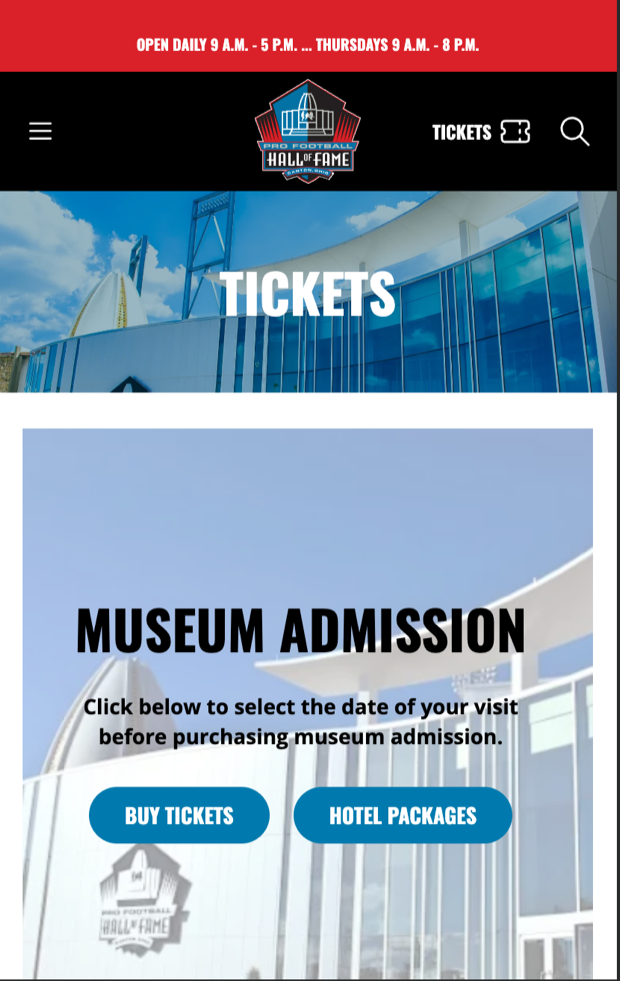
Screen 1 · The tickets splash page
 1
2
3
4
1
2
3
4
The primary CTA sits 1,090px down
Behind a full-screen decorative hero. White outline on a photograph, so contrast cannot be controlled: a WCAG 1.4.3 and 1.4.11 risk on the most important button on the site. Nothing warns that it opens a new tab on another company's domain.
Hotel Packages gets equal billing
Identical style, size and weight. Museum admission is about $400K a quarter; Hotel + Ticket Package is about $36.5K. An 11:1 revenue ratio given a 1:1 visual ratio. The page carries six buttons in all (Buy Tickets, Hotel Packages, Clash, VIP Tickets, Buy a Membership, Manage Tickets) and a price on none of them.
A third of the first screen is decoration
The hero carries one word. On the screen where a guest decides whether buying online is worth it, no price, no availability and no reason to act appear above the fold.
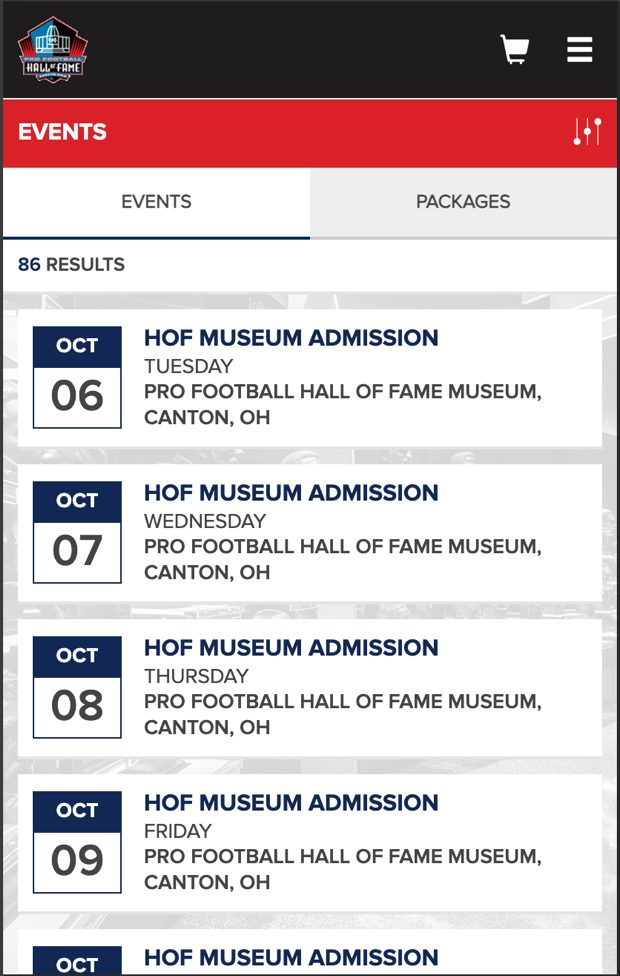
Screen 2 · Schedule
 1
2
3
4
1
2
3
4
86 identical rows, and still no prices
Every row carries the same product, venue and city. The only varying datum is the date. Buying for a date three weeks out means scrolling roughly 20 cards at about 210px each, close to 4,200px of thumb travel. No calendar, no Today, no This weekend.
"86 RESULTS" for one product
Search-results framing for a museum that is open every day. Desktop reported 87 in the same capture set. No availability signal, no busy or quiet guidance, no sold-out state.
The brand is gone
PFHOF's navigation, typography and colour system have been replaced by a black bar, a cart icon and a red EVENTS band. The guest is now shopping on a different company's website, with no transition and no warning.
The venue name, 86 times
"PRO FOOTBALL HALL OF FAME MUSEUM, CANTON, OH" repeats on every row of a single-venue product, taking two lines of a 210px card that carries one bit of information.
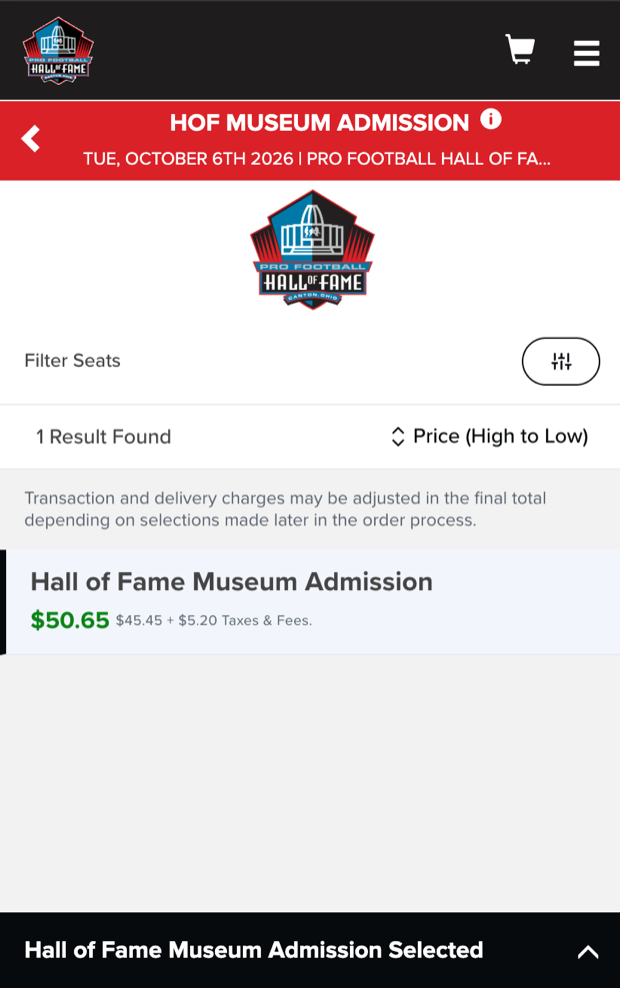
Screen 3 · Ticket list, as it loads
 1
2
3
4
5
1
2
3
4
5
One price. Three ticket types invisible.
This is the default state. Senior ($26.95), Child 6-12 ($42.00) and the $59 Fan Package are all in the catalog and none of them render. A senior couple reads $101.30 and would actually pay $53.90, a price 88% higher than reality. A family of four reads $202.60 and would pay $185.30.
The reveal control looks like a status message
Hall of Fame Museum Admission Selected ^ reads as confirmation that something has happened, not as a control. Its only affordance is a chevron, at the very bottom of the screen. A guest who does not tap it never learns the other prices exist.
About 350px of dead grey
Between the single price and the sticky bar. The screen has room to show all four ticket types with no scrolling, and uses it for nothing.
The page declares its own prices provisional
"Transaction and delivery charges may be adjusted in the final total depending on selections made later in the order process." On the screen where the guest is deciding whether to buy at all.
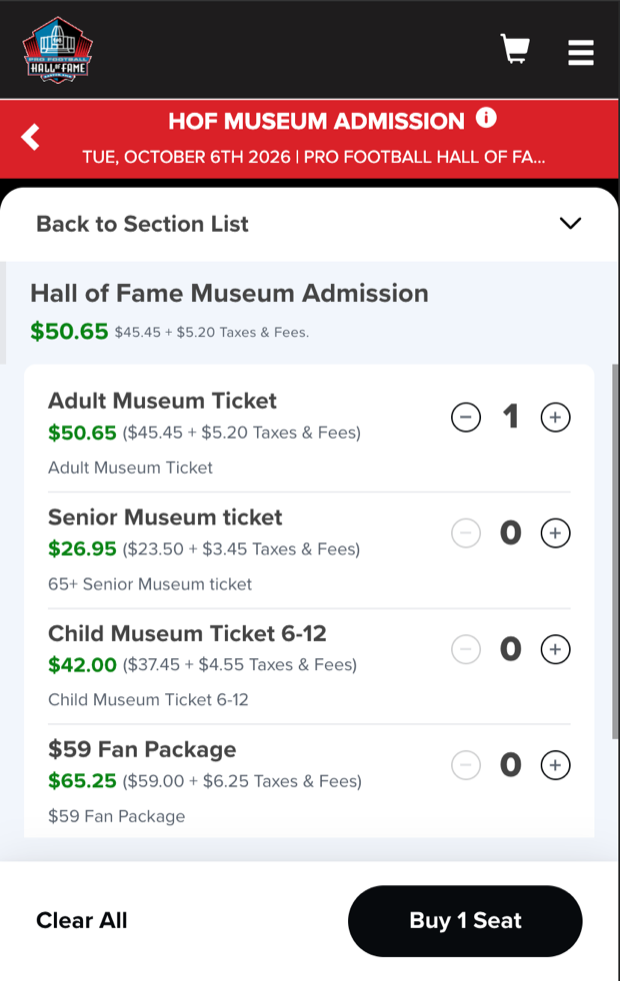
Screen 3b · The same screen, after the chevron
 1
2
3
4
5
1
2
3
4
5
Senior is 47% cheaper, and it was hidden
$26.95 against $50.65. The single highest-value piece of information on the screen is the one the default state withholds.
"$59 Fan Package" costs $65.25
The name contradicts the price in the same row. It is also the best attach offer in the catalog: $14.60 over adult admission for admission plus a t-shirt and a window cling, presented as the fourth row of a collapsed accordion with no image, no badge and no description of what is included.
"Buy 1 Seat"
A museum ticket is not a seat. The button also implies immediate purchase, when the next screen is a login wall. "Clear All" sits at equal weight beside it.
"Back to Section List"
There are no sections. The flow is running stadium software against a product with no seat map, no tiers and no assignments.
Screen 4 · The login wall
 1
2
3
4
1
2
3
4
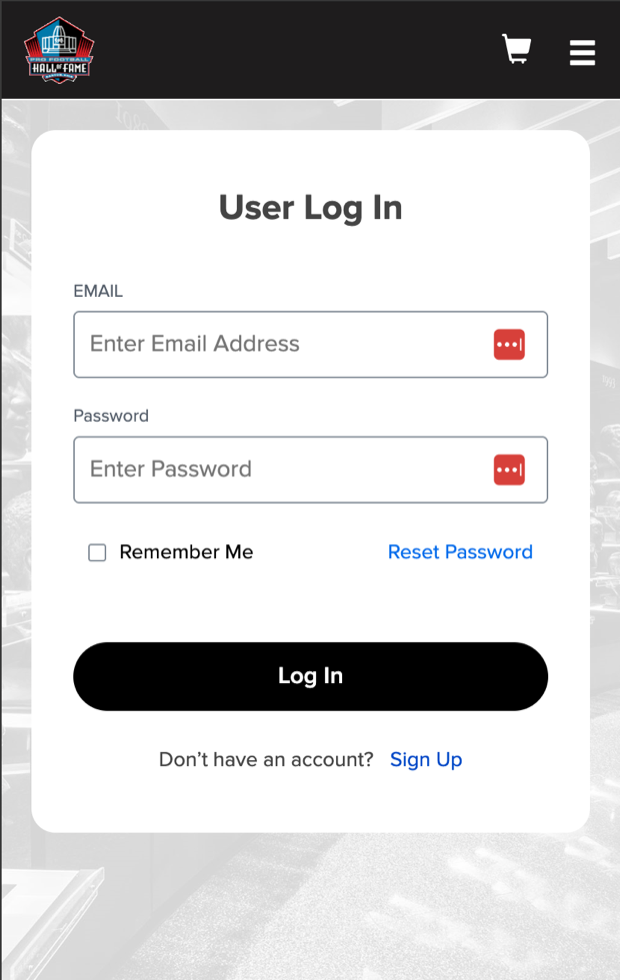
"User Log In"
Systems vocabulary addressed at a guest. Desktop reads "Log in or sign up to create an account"; the two breakpoints do not even share copy. No reason is given for why an account is required, and no benefit is stated.
The majority path is the small blue link
Most museum visitors are first-timers with no account. "Sign Up" is a text link subordinate to a full-width black Log In button. There is no guest checkout at all, the single most-cited conversion blocker in attraction ticketing.
No order summary, no total, no progress
The wall sits before the cart. The guest has committed selections but has never been shown a total. Nothing on screen says what they are buying, for which date, at what price, or how many steps remain.
The countdown is already running
A 10-minute cart timer started on the previous screen. A first-time guest is being asked to create an account from scratch, against a clock. No Apple, Google or social sign-in is offered.
Screen 5 · Cart and payment
 1
2
3
4
1
2
3
4
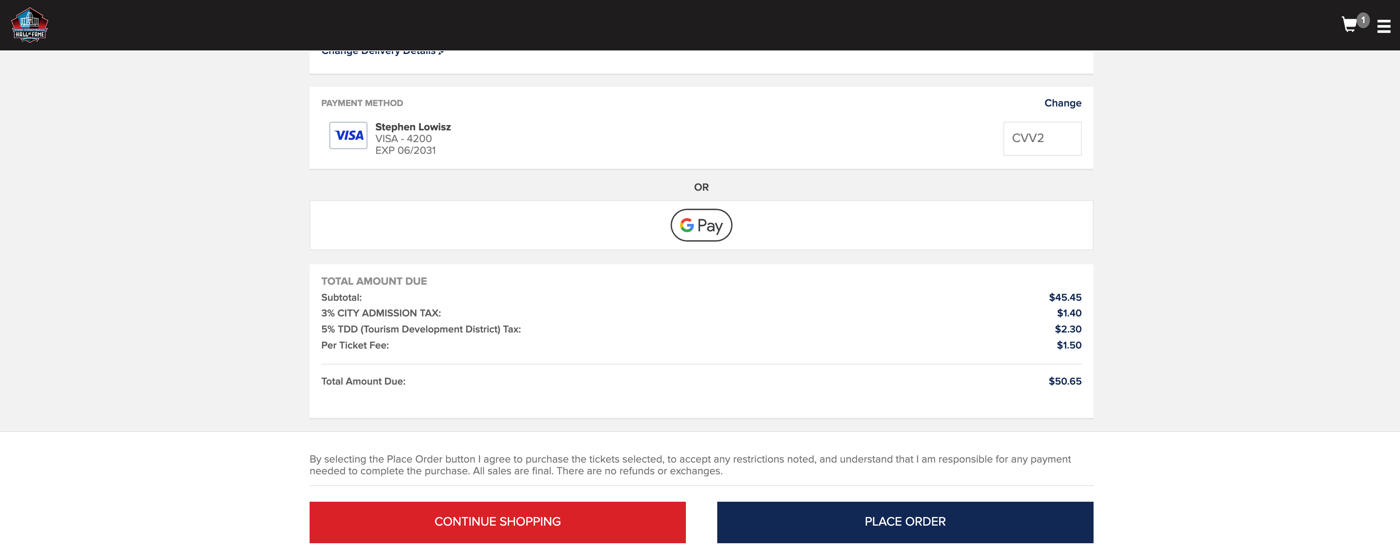
The loudest button abandons the order
CONTINUE SHOPPING is red, the most attention-grabbing colour in the palette, and sits to the left of the navy PLACE ORDER. The abandoning action outranks the converting action in both position and colour weight. On mobile the order is corrected, but red CONTINUE SHOPPING then sits directly below PLACE ORDER, at the bottom of the screen, where a thumb lands most easily.
$1.50 of the $5.20 is a choice
City Admission Tax ($1.40) and TDD Tax ($2.30) are statutory. The Per Ticket Fee of $1.50 is discretionary: about $13,905 a quarter, $55.6K a year. Griffin MSI, the comparison the team cites for moving online share from 13% to 61%, advertises no processing fee.
"All sales are final. There are no refunds or exchanges."
On a dated, weather-exposed product. Advance purchase costs $1.50 more than walking up and surrenders all flexibility. Every guest unsure of their date is behaving rationally by choosing the box office.
Google Pay only, and the price flipped
Apple Pay was not observed on either breakpoint. The ticket list sold $50.65 all-in; the cart line above reads $45.45, and the guest must scroll to find that the total is $50.65 after all. No secure-payment mark, no service number, no policy link.
Screen 6 · Confirmation
 1
2
3
1
2
3
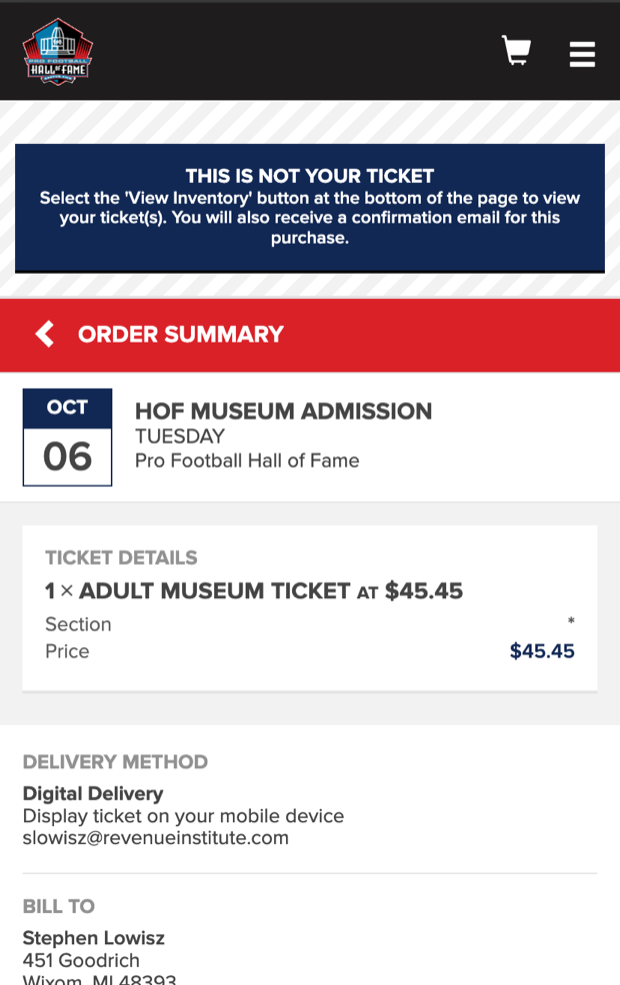
"THIS IS NOT YOUR TICKET"
Bold, above the fold, in a navy alert block. The guest has just paid $50.65 and the page opens by telling them they do not have what they bought, then sends them to "View Inventory" to go and find it.
Headed "ORDER SUMMARY", not a confirmation
No thank-you, no celebration, no arrival information, no parking, no hours, no what to see first. The emotional high point of the purchase is spent on a receipt.
Screen 7 · Ticket retrieval
 1
2
3
4
1
2
3
4
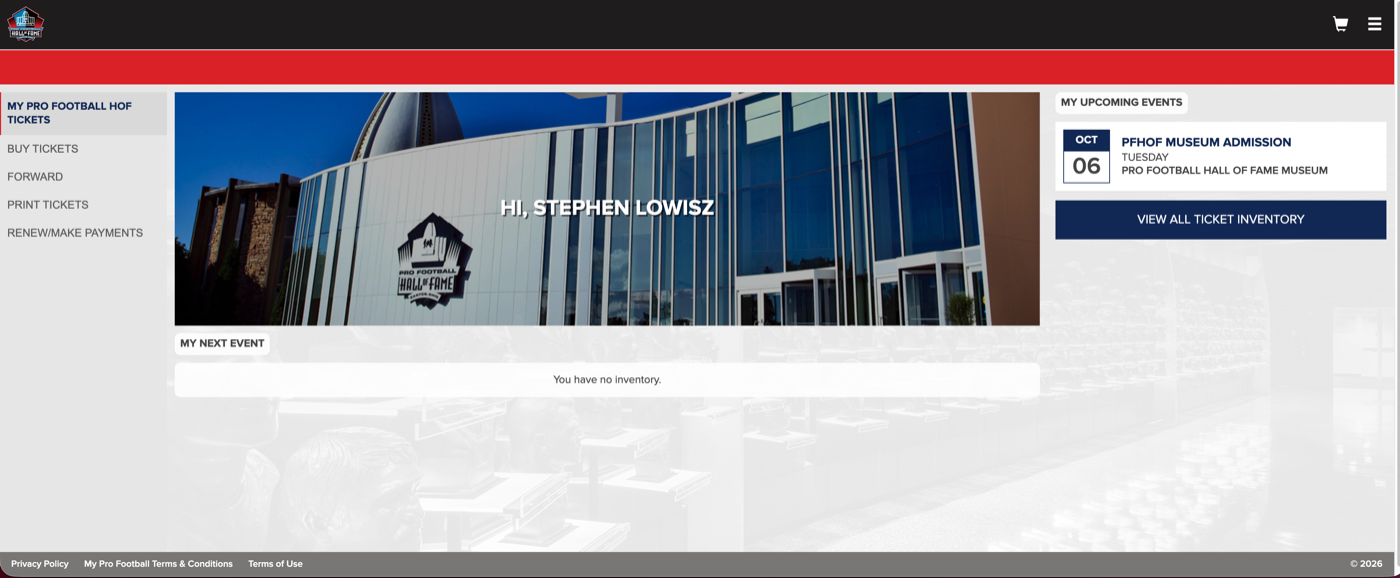
"You have no inventory."
The guest was told their receipt was not their ticket, clicked VIEW INVENTORY as instructed, and landed here. The panel headed MY NEXT EVENT tells them they own nothing.
While the ticket is listed, on the same screen
MY UPCOMING EVENTS shows OCT 06 · PFHOF MUSEUM ADMISSION at the same moment. The page contradicts itself inside one viewport. The product is also named PFHOF here, HOF on the schedule, and Hall of Fame on the ticket list: three names inside one purchase.
Season-ticket-holder navigation
FORWARD, PRINT TICKETS, RENEW/MAKE PAYMENTS. A one-time museum guest is handed the account tools of a season ticket holder, including a paper-era retrieval verb.
And still not the ticket
VIEW ALL TICKET INVENTORY is a second inventory button, on a second ProVenue tenant
(orgid=53800, a different org from the one that sold the ticket). Mobile needs
two further taps after this. A manual refresh icon sits in the header: the interface
anticipates its own list will be stale.
Appendix · The same ticket screen on desktop
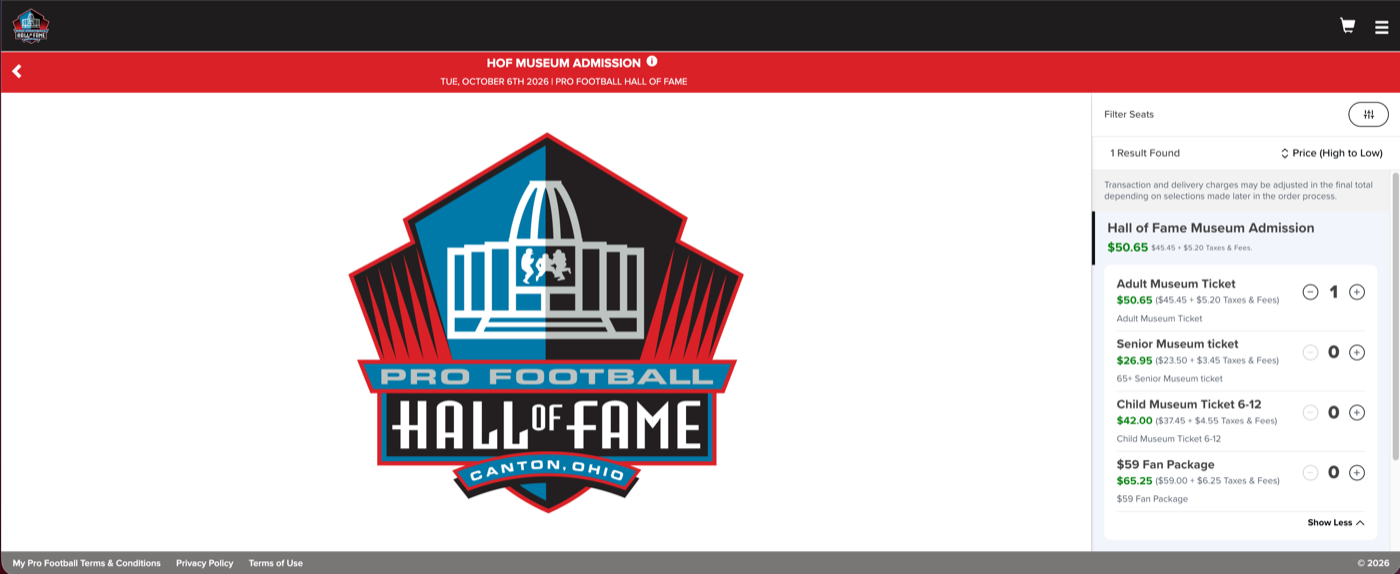 1
2
1
2
A static crest, at 70% of the viewport
It carries no information, changes nothing, and cannot be interacted with. On the screen where a guest chooses what to buy, two-thirds of a 1,786px canvas is a logo.
The entire purchase lives in a 440px rail
Four ticket types, quantity steppers, the coupon field and the CTA are compressed into a column narrower than a phone, on a desktop screen with room to show a calendar, every price, and a running total at once.
Seven screens, and not one of them gives a guest the three things they need at the moment they need them: what dates are available, what it costs for their party, and how to pay. The price appears on screen four. The full price list appears only after an unlabelled chevron. The total appears only after an account is created. And the ticket appears three taps after the money is gone.
Pricing and catalog
The ladder is upside down in the middle
A 12-year-old pays $15.05 more than a 65-year-old, 56% more. For a family destination, a child price at 83% of adult is unusually high, and it is the price point that most directly governs whether a family of four completes. Two adults plus two children is $185.30 all-in. That is the number the flow should be designed around, and it is a number the flow never shows.
The Fan Package is the best attach offer in the catalog and it is invisible
$65.25 all-in is $14.60 over adult admission for admission plus a t-shirt and a window cling. Structurally the same move as the National WWII Museum's "Best Value, only $3 more" nudge the team calls out. Today it is the fourth row of a collapsed accordion, with no image, no badge, no description of contents, and a name that contradicts its own price.
The discretionary fee
The $1.50 per-ticket fee across 9,270 tickets per quarter is about $13,905 per quarter, $55.6K annualised. The one lever entirely within PFHOF's control.
What changed between the two walks
The team's benchmark walked this flow on September 30 and recorded adult admission at $49.55 = $44.45 + $5.10. Our captures six days later show $50.65 = $45.45 + $5.20. Both reconcile exactly once the two taxes are rounded up to the nearest nickel.
Sept 30    44.45 + 1.35 (3%) + 2.25 (5%) + 1.50 fee = 49.55
Oct 6      45.45 + 1.40 (3%) + 2.30 (5%) + 1.50 fee = 50.65
           base +$1.00                    fee unchanged
An earlier draft of this audit inferred that the per-ticket fee had risen from $0.40 to $1.50. It had not. The fee has been $1.50 in both walks. What moved is the base price, up $1.00 or 2.25%, in the six days between September 30 and October 6.
Three prices for one ticket
The benchmark also records /visit advertising adult admission at
$45.95, which is the base plus the $1.50 fee and excludes the 8% in
taxes. On September 30 the same ticket was therefore presented three ways on three pages.
| Where | Price shown | What it includes |
|---|---|---|
/visit | $45.95 | base + fee, no tax |
| Ticket list | $49.55 | all-in |
| Cart line item | $44.45 | base only |
/visit showed $45.95 against a $44.45 base. The same construction on
the current $45.45 base is $46.95.
The catalog changed last week, and the team's notes were right when written
The note that "only Adult and Child are sold online" was accurate on September 30. The benchmark walk recorded exactly two types, and explicitly no military, senior or local rate. Our October 6 captures show four.
| Ticket type | Sept 30 | Oct 6 | Change |
|---|---|---|---|
| Adult | $49.55 | $50.65 | base +$1.00 |
| Child 6-12 | $42.00 | $42.00 | unchanged |
| Senior 65+ | not sold | $26.95 | added |
| $59 Fan Package | not sold | $65.25 | added |
Two things follow. Senior and the Fan Package went live inside a six-day window, which is encouraging: TDC and PFHOF can add a buyer type quickly, so the ladder is not frozen. And because adult rose while child did not, the child price moved from 84.8% to 82.9% of adult, widening the gap the family-of-four economics already sit on.
This matters beyond correcting the record. Ticket types and prices vary by event instance in ProVenue. The Experience Layer cannot hard-code a ticket ladder. It must render whatever the catalog returns for the selected date, including types nobody has told us about. That is a requirement for the technical architecture plan (SOW §1.2.2.4) and the Functional Specification (§1.2.2.3).
Where Canton sits in the peer set
Adult general admission as published, across the halls of fame in the team's 18-attraction benchmark.
| Hall of fame | Adult GA | Checkout |
|---|---|---|
| Pro Football HoF | $45.95 | Generic vendor page |
| Rock & Roll HoF | $45.00 | Own subdomain |
| College Football HoF | $38.00 | Own subdomain |
| Baseball HoF | $35.00 | Blackbaud |
| Country Music HoF | $31.95 | Own subdomain |
| Naismith Basketball HoF | $30.00 | Etix |
| NASCAR HoF | $27.00 | Own subdomain |
Canton is the most expensive hall of fame in the set, and one of the few that hands checkout to a generic vendor page. It charges 70% more than NASCAR HoF and 44% more than Country Music HoF, both of which sell a tiered ladder on their own subdomain.
Against the wider set it prices above every museum benchmarked (MoMA and The Met at $30, Art Institute $32, WWII Museum $27, Griffin MSI $25.95) and is beaten only by Georgia Aquarium at $54.99, which prices by date, sells three add-on screens and a donation round-up, and offers guest checkout.
The benchmark's own framing of the gap: the Hall asks fans which date and sends them to a vendor page, while the best attractions ask what kind of day they want, show a price on every choice, keep everything in one cart, and keep selling after payment.
The refund policy
A policy decision rather than a UI defect, and it may be the largest single structural brake on advance online purchase.
Museum admission is bought for a specific future date. The guest is asked to make an irreversible commitment to a day on which it may rain, a child may be sick, or a drive from Cleveland may not happen. The box office carries zero commitment risk: you decide at the door.
The current flow prices advance purchase at a $1.50 premium and a total loss of flexibility, versus walking up. Every guest who is not certain of their date is behaving rationally by choosing the box office.
Meow Wolf, cited in the team's references, offers self-serve rescheduling. That single capability converts a dated commitment into a dated intention, which is a fundamentally easier sale.
No exchange, date-move or self-serve reschedule path exists anywhere in the current flow. Date-change self-service belongs in the Functional Specification as a Phase 1 requirement. No amount of front-end work fully compensates for its absence.
Where guests are lost
The abandonment sits between the cart and payment, which is exactly where section 03 places the login wall, the 10-minute countdown, and the final-sale notice.
Supporting signals
| Signal | Count | Read |
|---|---|---|
| Login events | 48,784 | 12.2 logins per purchase |
| Login sessions | 35,698 | More than the 10,523 add-to-cart sessions. Most logins are not buying. |
| Sessions that start a form | 50,548 | |
| Sessions that submit a form | 11,849 | 23.4% |
| Ticket-retrieval sessions | 51,056 | 12.7 per order placed |
Form metrics are browser-level and will also capture filter and search forms. Treat the 23.4% as directional.
Two readings worth stating plainly. There are more login sessions than cart sessions. Logging in is not primarily a step toward buying. It is predominantly people returning to retrieve a ticket they already own, which is exactly what screen 7 would predict. And 51,056 retrieval sessions against 4,005 orders is roughly 13 retrieval visits per order, the clearest quantitative proof that the post-purchase experience is broken.
Guests add tickets one at a time
Each add-to-cart action carries 1.10 tickets on average, while a completed order carries 2.31. A typical purchase therefore involves roughly two separate add-to-cart actions, consistent with the stepper-per-ticket-type interface on screen 3, and a reason the interface should present a family or group as a single decision rather than a sequence of them.
Entry points
Where museum ticket buyers actually arrive, measured as museum tickets per 1,000 sessions.
| Landing page | Sessions | Tickets | Per 1k | Museum revenue |
|---|---|---|---|---|
/schedule/?agency=FHOF_PL_MPV&orgid=53799 | 13,140 | 1,610 | 122.5 | $69,472 |
/tickets · Ads, kw "pro football hall of fame tickets" | 880 | 88 | 100.0 | $3,716 |
/tickets · Ads, kw "pro football hall of fame" | 697 | 64 | 91.8 | $2,770 |
/tickets · Ads, hsa_cam=24031067003 | 21,871 | 1,480 | 67.7 | $63,821 |
/tickets · organic | 21,851 | 1,337 | 61.2 | $57,781 |
/visit | 10,318 | 323 | 31.3 | $13,970 |
/ticketmanagement/?agency=FHOM_MYTIXX&orgid=53800 | 3,643 | 90 | 24.7 | $3,849 |
/ homepage | 159,222 | 2,661 | 16.7 | $114,938 |
/?orgId=53799&agency=FHOF_PL_MPV&eventid=151322 | 9,774 | 36 | 3.7 | $1,690 |
/?agency=FHOM_MYTIXX&orgid=53800 | 47,413 | 163 | 3.4 | $7,073 |
/enshrinement | 11,165 | 37 | 3.3 | $1,638 |
/enshrinement/2026-enshrinement-week-schedule-of-events | 13,730 | 30 | 2.2 | $1,320 |
/events | 14,103 | 27 | 1.9 | $1,156 |
/events/class-of-2026-enshrinement | 62,391 | 24 | 0.4 | $1,060 |
/events/arizona-cardinals-vs-carolina-panthers-... | 40,114 | <24 | <0.6 | - |
The deep link is pointed at the weakest screen in the flow
The eventid=151322 link takes 9,774 sessions directly onto the
collapsed ticket-detail screen, the one that shows a single $50.65 price with the other three
ticket types hidden. It produces 36 tickets: 3.7 per 1,000 sessions, against 122.5 on
/schedule. A 33x gap. Repointing it is a link change, available immediately, with no
build.
The biggest football audiences have no museum path
| Page | Sessions | Museum tickets |
|---|---|---|
/events/class-of-2026-enshrinement | 62,391 | 24 |
/events/arizona-cardinals-vs-carolina-panthers-2026-hall-of-fame-game | 40,114 | fewer than 24 |
| Combined | 102,505 | fewer than 48 |
These are the second and fifth largest landing pages on the property, carrying the most
engaged football audience PFHOF has: people reading about enshrinement week and the Hall of Fame
Game. For comparison, /schedule turns 13,140 sessions into 1,610 tickets.
102,505 sessions produce fewer than 48 museum tickets. There is no admission offer on these pages. This is the largest untapped cross-sell surface in the audit and it requires content, not engineering.
/schedule outperforms everything, including /tickets
The best-converting entry point is the tickets.com schedule itself, roughly 2x
/tickets and 7x the homepage. Guests who arrive already knowing they want a date
convert far better than guests who must first pass through a priceless splash page. That argues
for putting the date choice and prices on /tickets itself rather than treating it as
an interstitial.
Traffic sources
Display (1,071 sessions) and Organic Video (95 sessions) produced no museum tickets and are omitted from the chart.
Paid Search returns $1,711 of museum ticket revenue per 1,000 sessions. Paid Social returns $5.33. A 321x difference. Paid Social carries 5.3x the traffic of Paid Search and produces 1.7% of the tickets, 9 against 534.
| Channel | Sessions | Tickets | Est. orders | CVR | Rev / 1k | Museum revenue | Cart → buy |
|---|---|---|---|---|---|---|---|
| Paid Search | 13,613 | 534 | 231 | 1.698% | $1,711 | $23,298 | 60.8% |
| Cross-network (PMax) | 84,136 | 1,839 | 796 | 0.946% | $941 | $79,189 | 61.1% |
| AI Assistant | 4,902 | 41 | 18 | 0.362% | $368 | $1,803 | 65.1% |
| Organic Search | 634,966 | 4,382 | 1,897 | 0.299% | $298 | $189,198 | 59.5% |
| Organic Shopping | 2,920 | 17 | 7 | 0.252% | $254 | $742 | 47.2% |
| Direct | 377,117 | 2,092 | 906 | 0.240% | $239 | $90,110 | 62.3% |
| Unassigned | 42,829 | 122 | 53 | 0.123% | $124 | $5,315 | 49.8% |
| Referral | 77,614 | 184 | 80 | 0.103% | $105 | $8,152 | 45.3% |
| 17,021 | 33 | 14 | 0.084% | $85 | $1,449 | 46.5% | |
| SMS | 3,324 | 2 | 1 | 0.026% | $27 | $89 | 50.0% |
| Paid Other | 5,190 | 3 | 1 | 0.025% | $26 | $133 | 100% |
| Organic Social | 44,854 | 12 | 5 | 0.012% | $12 | $533 | 32.4% |
| Paid Social | 71,987 | 9 | 4 | 0.005% | $5 | $384 | 22.0% |
| Display | 1,071 | 0 | 0 | 0% | $0 | $0 | - |
| Organic Video | 95 | 0 | 0 | 0% | $0 | $0 | - |
| Total | 1,381,639 | 9,270 | 4,005 | 0.290% | $290 | $400,394 | 59.7% |
The Meta cluster, rolled up
| Source | Sessions | Museum tickets |
|---|---|---|
meta / paid | 44,119 | 5 |
meta / paid_social | 19,192 | 4 |
meta / facebook | 11,101 | 7 |
facebook / paid | 5,928 | 0 |
fb_dark / cpc | 4,794 | 0 |
ig / social | 850 | 4 |
meta / paidsocial, fb / paid | 1,445 | 0 |
| Total | 87,429 | 20 |
About 87,400 sessions produced 20 museum tickets and $873, roughly $10 per 1,000 sessions
against $1,060 for google / cpc.
Meta is not failing outright. Paid Social generates $42,769 across all products; only 0.9% of it is museum admission. Meta is working for retail, concerts and events. It is not working for museum admission.
Museum admission as a share of each channel's revenue
| Channel | Museum share of channel revenue |
|---|---|
| Referral | 90.2% |
| AI Assistant | 89.7% |
| Paid Search | 82.9% |
| Organic Search | 72.9% |
| Cross-network | 40.9% |
| Direct | 38.9% |
| 5.3% | |
| Paid Social | 0.9% |
Close rate is flat across every channel
Organic 59.5%, Direct 62.3%, Cross-network 61.1%, Paid Search 60.8%. Intent varies enormously by source; close rate does not. The checkout, not traffic quality, is the constraint, and a checkout fix compounds across every channel simultaneously.
Google paid is the most efficient ticket channel by a wide margin
google / cpc runs 96,269 sessions into 2,364 tickets and $102,094:
24.56 tickets per 1,000 sessions, 3.8x more efficient per session than
google / organic at 6.51.
Coupon-site referrals confirm the coupon-field leak
About 37 tickets arrive via coupon aggregators (simplycodes 17, worthepenny 13, hotdeals 5, dealdrop 2), converting at roughly 43 tickets per 1,000 sessions, among the highest rates on the property.
This is direct evidence for the coupon field on screen 3, which surfaces a coupon box before the guest has chosen a ticket. Guests see it, leave to hunt for a code, and a measurable share return through an aggregator. The ones who come back convert well. The ones who do not are invisible.
Three smaller signals
- Wikipedia sends 33,031 sessions and zero museum tickets. The sixth-largest
traffic source on the property, with no path into the buy flow. Same for
nfl.com / referralat 2,122. - AI assistants punch above their weight. ChatGPT: 4,631 sessions, 37 tickets, 7.99 per 1,000, better than Google organic (6.51) and direct (5.55), with the highest cart-to-purchase rate of any channel at 65.1%. Small today, high intent, 89.7% museum admission. Admission prices, hours and ticket types should be published in machine-readable form.
- Travel partners are the highest-intent referrers, except the local one.
reservations.arestravel.comconverts at 47.6 tickets per 1,000 sessions on 483 sessions, the highest rate on the property.thisiscleveland.comruns 21.1. Butvisitcanton.com, the local destination marketing organisation at 2,045 sessions, produces one ticket: the worst-converting travel referrer in the set.
Defect register
37 defects, ranked by estimated revenue impact.
Opportunity sizing
Stated as objectives, consistent with SOW §6.1, which provides no revenue or conversion guarantee.
Two levers, each tied to specific defects.
| Scenario | Entry | Close | Orders / 90d | Delta | Annualised |
|---|---|---|---|---|---|
| Today | 7.03% | 38.3% | 4,030 | - | - |
| Conservative · lever 1 only | 7.03% | 45% | 4,735 | +705 | ~$282K |
| Mid · both levers, modest | 8.0% | 45% | 5,391 | +1,361 | ~$544K |
| Ceiling · both levers | 10.0% | 55% | 8,236 | +4,206 | ~$1.68M |
Covers existing tickets.com traffic only. Excludes any shift from box office to advance purchase, the stated purpose of the engagement and still the largest unquantified upside.
Available without any build
| Action | Basis |
|---|---|
Repoint the eventid=151322 deep link to /schedule | 9,774 sessions at 3.7 vs 122.5 tickets per 1k |
| Add an admission offer to the two largest event pages | 102,505 sessions, fewer than 48 tickets |
| Review Meta targeting for admission | About 87,400 sessions, 20 tickets |
| Shift media weight toward Google paid | $1,711 and $941 per 1k vs $5 for Paid Social |
| Ask visitcanton.com what their link points at | 2,045 sessions, 1 ticket |
Attach and fee
About 1 in 10 online attraction bookers adds an upsell (ROLLER, vendor-reported), so the 10% row is the industry-typical case rather than the optimistic one. Insider's Tour and MVP Membership prices do not appear in any supplied material, so neither is modelled here. Removing the $1.50 fee buys a "no booking fee" claim: Griffin MSI charges no processing fee and moved its online share from 13% to 61%.
Scope conflicts and gaps
Flagged now rather than after, per the standing working agreement.
11.1 · Membership is excluded by the SOW but requested by the client
SOW §1.5.4.6 expressly excludes ticketing flows other than museum general admission, including memberships. The team asks for member pricing recognised in the flow, MVP Membership as an add-on, and a membership credit on the confirmation page.
Proposed resolution: membership is currently sold through coupon codes
(the benchmark records five tiers: RKEMEM, STRMEM, CAPMEM,
PROMEM, MVPMEM), and a discount-code field already exists in the flow. Recognising member pricing via code redemption is
general-admission pricing logic, not a membership flow, and sits inside scope. Selling or
renewing a membership does not. Revenue Institute's position is that member pricing is in scope
and membership sales are not.
11.2 · Post-purchase upsell is not in the Phase 2 deliverable
SOW §1.3.2.4 scopes upsell screens presented prior to checkout. The team asks for a confirmation page that keeps selling.
SOW §1.4.2.2 hands the transaction and payment off to the TDC Platform. If TDC renders the confirmation, PFHOF cannot own that screen at all: no upsell, no wallet pass, no arrival content, and no fix for D3 or D5.
TDC renders the confirmation page today, on mpv.tickets.com. Until TDC states otherwise, the Experience Layer cannot be assumed to own that screen, and the Phase 1 mockup should not be signed off on the assumption that it can.
11.3 · Apple and Google Wallet depend entirely on TDC
SOW §1.1 makes TDC the system of record for fulfilment, and §1.5.4.1 excludes payment processing. Wallet pass generation is a ProVenue capability question, not a front-end one, and it appears in no deliverable list in the SOW. No wallet pass is offered anywhere in the current flow.
11.4 · A/B testing is explicitly outside the four phases
The SOW places split-testing under §7.1.3 Optional Ongoing Engagement, billed at $200/hr after the 30-day hypercare period. If the client expects experimentation at launch, that is a change order under §3.6 and should be priced now, not discovered in Phase 4.
11.5 · Box-office QR sits near an exclusion
SOW §1.5.4.4 excludes box-office, kiosk and onsite interfaces, and §1.5.4.7 excludes content creation. A QR that deep-links to the mobile flow is neither a kiosk nor a content deliverable, and is close to free to provide. Revenue Institute supplies the destination URL and tracking parameters; PFHOF produces the signage.
11.6 · Databox and HubSpot dependencies
§1.4.2.5 routes ticketing data into Databox only if the separate BI SOW is executed before Phase 3 fulfilment. §1.4.2.7 commits to direct HubSpot integration with purchase and identity events. HubSpot appears in that clause and in no other supplied material.
Limits of the record
What the supplied materials, the captures and the benchmark do not establish.
- The box office versus online split for museum admission does not appear in any supplied material. Shifting admissions from onsite to advance online purchase is the engagement's stated purpose, and that baseline is unmeasured.
- No under-6 admission policy appears anywhere in the buy flow or on the ticket list.
- Insider's Tour and MVP Membership prices do not appear in any supplied material. Both are named in the team's requirements as upsells.
- ProVenue's support for date change, exchange and wallet pass generation is not documented in any supplied material. None of the three is exercised anywhere in the current flow.
- The confirmation page is rendered by TDC on mpv.tickets.com. SOW §1.4.2.2 hands transaction and payment off to the TDC Platform. Whether the Experience Layer can own that screen is not established by any supplied material.
- The registration form was never captured. It sits between a committed guest and the cart, behind a running countdown, and its field count is unknown.
- The source of the 9,774 sessions landing on the
eventid=151322deep link is not identified in any supplied material. - HubSpot appears in SOW §1.4.2.7 and in no other supplied material. Nothing establishes it as the CRM of record for ticket buyers.
- The companion POV, target flow and roadmap artifact linked from the benchmark is unavailable. The team's proposed future state is not reflected in this audit.
- Industry percentages quoted from the benchmark are vendors' own claims (ROLLER, Convious), per that document's own note.
Recommended actions
Before October 14.
| # | Action | Why | Owner |
|---|---|---|---|
| 1 | Repoint the eventid=151322 deep link to /schedule | 9,774 sessions at 3.7 vs 122.5 tickets per 1k. A link change. | PFHOF / media |
| 2 | Add a museum admission offer to the enshrinement and HOF Game pages | 102,505 sessions, fewer than 48 tickets. Content, not engineering. | PFHOF |
| 3 | Resolve the scope conflicts in 11.1, 11.2 and 11.4 in writing | 11.2 changes the shape of the design. Resolving now is free; discovering in Phase 3 is a change order. | RI + SEA |
| 4 | Get the box-office vs online split | It is the project's success metric and is not currently measured. | PFHOF / Cheryl |
| 5 | Review Meta targeting against museum admission | About 87,400 sessions, 20 museum tickets, $873. | PFHOF / SEA |
| 6 | Consolidate the admission product name across schedule, ticket list and retrieval | Three names inside one purchase (D20). | PFHOF / TDC |
| 7 | Decide the policy question in section 05 before the mockups | Refundability or date-change capability changes what the buy flow can promise, which changes the design. | PFHOF exec |
What best in class does
The mechanics below are what the eighteen attractions in the team's benchmark actually do. Every row is observed behaviour, not aspiration.
| Mechanic | Who does it | As built |
|---|---|---|
| Price on every date | Georgia Aquarium, Meow Wolf, Edge NYC | $54.99 weekdays against $57.99 Saturday; Edge's Advance Saver runs up to 35% off at 14+ days out |
| Experience ladder before the date | Country Music HoF, WWII Museum, NASCAR HoF | "Select Your Experience" from $31.95 to an $82.95 all-in; WWII sells seven levels from $27 to a $296 curator-led vault tour; NASCAR runs $36 / $41 / $49 |
| Best-value nudge | WWII Museum | The $39 tier is outlined and labelled "Only $3 more! Perfect for first-time visitors" |
| Member price shown inline | Griffin MSI, Rock Hall | Member price beside every item; "Members FREE" with a login button next to the ticket |
| Resident and local rates | Art Institute, The Met, Rock Hall, Griffin MSI | City and state tiers; NY residents pay what they wish; Cleveland residents free; free days checked by ZIP |
| Guest checkout | Rock Hall, Georgia Aquarium | Rock Hall by default, name, email and ZIP, no password; Georgia Aquarium offers it below the fold |
| Add-ons in one cart | Georgia Aquarium, Griffin MSI | $30 parking, $20 cafe combo, round-up donation; Griffin fits up to 14 timed add-ons on one ticket |
| Flat, small order fee | SUMMIT, Edge NYC, Griffin MSI | $3 per order; $2 per order; no processing fee at all |
| Wallet delivery | Meow Wolf | Tickets go into Apple Wallet from the confirmation |
| Self-serve reschedule | Meow Wolf | The guest changes their own date without contacting anyone |
| Upgrade after purchase | Meow Wolf, Edge NYC | Upgrade to a Portal Pass; Edge charges only the price difference |
| Ticket credited to membership | Georgia Aquarium, College Football HoF, Rock Hall | Within 60 days; within 14 days; "turn your ticket into a membership" |
| Labelled progress | Van Gogh, WWII Museum | Five named steps; Menu, Tickets, Review, Pay, Confirm |
| Quick date picks | Rock Hall | Today / Tomorrow / Another Date, with three numbered steps on one page |
| Date-specific upsell | Rock Hall | Backstage Stories offered for the day chosen, plus a parking advisory for Browns home games |
Canton's secondary flows, as they stand
| Flow | Today | Best in class |
|---|---|---|
| Membership | Sold on mpv.tickets.com by typing a coupon code per tier: RKEMEM, STRMEM, CAPMEM, PROMEM, MVPMEM. No offer in the visit flow, and no way to credit a ticket toward membership. | Rock Hall shows "Members FREE, log in" beside ticket prices. Georgia Aquarium credits a ticket toward membership within 60 days. |
| Hotel packages | Goes to reservations.arestravel.com: a separate site, cart and receipt. | Rock Hall uses the same vendor on its own subdomain, reservations.rockhall.com, and sells a $65 Hall Pass with Canton admission included. Canton does not list that combination. |
| Enshrinement VIP | Sold by On Location (onlocationexp.com) with its own checkout. | Premium tiers sit on the same ladder as admission: WWII's $296 Into the Vault, SUMMIT's $149, Edge's $179. |
College Football Hall of Fame already carries reciprocal benefits with Canton. Rock Hall is currently the only party selling a Canton bundle.
Industry figures the benchmark cites
Reported by ticketing vendors about their own customer bases, per that document's note.
| Figure | Claim | Source |
|---|---|---|
| 83% | of online attraction bookings are on mobile | ROLLER |
| 43.5% | larger order value when paid by digital wallet | ROLLER |
| 1 in 10 | online bookers adds an upsell | ROLLER |
| 261.5% | more frequent visits by members | ROLLER |
| 68% / 61% | oppose peak surcharges / back off-peak discounts | Convious |
The first two bear directly on two items the current flow lacks: a mobile-first purchase and a wallet pass. The third sets the Fan Package attach model in section 10. Sphere, on Ticketmaster at roughly $22 or more in fees per ticket, is the benchmark's counter-example.
A museum admission purchase is three decisions: when, who, how many.
There is no time slot, no seat, no section, no assignment. It is structurally simpler than the Rock & Roll Hall of Fame flow the team calls the fastest in the reference set.
The current flow spends thirteen screens, twelve taps, two domains, two tenants and two brand systems on those three decisions. It hides the price until the fourth screen, hides three of four ticket types behind an unlabelled chevron, demands an account before showing a total, runs a countdown while it does so, opens the receipt by saying "this is not your ticket," and then tells the guest they have no inventory.
The target is one screen: a calendar with all-in prices on every date, ticket-type steppers with every price visible, a running total, guest checkout, and a wallet pass.
Everything else in the current flow is ceremony inherited from stadium ticketing.